Supporting Impulse Control Behavior in The Classroom

If you’ve spent any amount of time with kids, especially in a classroom, you already know impulse control is one of the hardest skills for them to develop. One moment they’re quietly working, and the next they’ve blurted out an answer before you even finished the question, rushed through a task without thinking, grabbed something from a peer, or taken off across the room like they’re chasing a squirrel only they can see.
Sure, some children may have impulse control disorders or autism spectrum disorder, but a child’s impulsive behavior isn’t just tied to these. Poor impulse control can be a problem for typically developing students, as well.
When we talk about impulse behavior in younger children we’re talking about quick reactions, fast emotions, maybe risky behaviors, but overall problematic behaviors that can lead to disruptions in the classroom. They are the actions that happen way before the thinking really kicks in.

OVERLOADED caseload? No idea how you are going to manage it all? This Summit is for you.

calling all SPED Teachers
OVERLOADED caseload? No idea how you are going to manage it all? This Summit is for you.
And here’s the truth:
It’s not simply defiance. It’s not simply a lack of respect. It’s not simply “bad behavior.”
For most kids, it’s simply a lack of skill.
Impulse control is learned slowly, albeit kind of inconsistently throughout the years. They learn it through years of modeling, practicing, failing, trying again, and building the brain pathways that help kids pause before reacting. Some children develop these skills more naturally through experience and maturity, while others need a more hand-holding and an intentional, explicit approach.

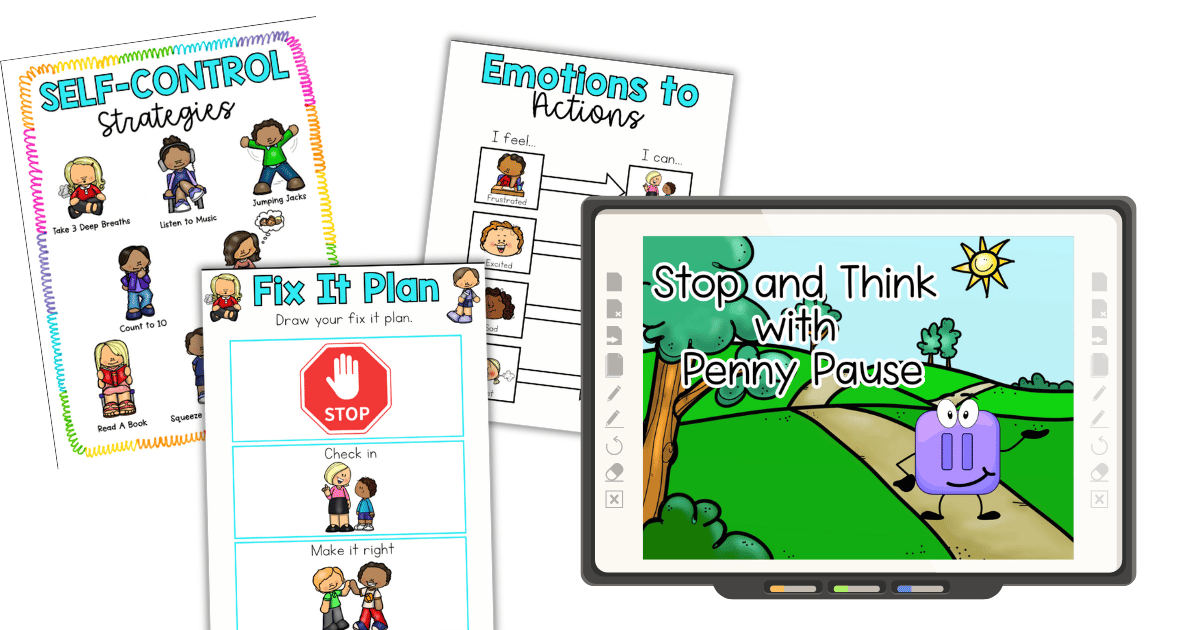
That’s where teaching comes in. And that’s where resources like the Self-Control Mini Unit can be a huge benefit to you if you work with school-age children. The unit breaks down a very complex skill into something children can see, understand, and practice daily.
Before we talk about how to strengthen impulse control, let’s talk about why so many kids struggle with it in the first place.
Why Impulse Behavior Happens
If you’ve ever wondered, “Why does this child act before thinking all the time?,” you’re not alone.
Impulsivity is incredibly common, and it doesn’t always mean there’s a disorder or diagnosis behind it. For many children, the reason is simply developmental. The part of the brain responsible for impulse control, our prefrontal cortex, is still under construction at these young ages. Expecting a six year old to act with the restraint of an adult is, in many ways, developmentally unrealistic (and I’ve been there trying to make it work, by the way, and it doesn’t).
Layer big emotions, lack of emotional regulation, on top of that, and things escalate quickly. Young children feel intensely, and when they’re overwhelmed, excited, frustrated, or surprised, the reaction tends to come out before any sort of pausing or thinking can happen.
When you add sensory needs or sensory processing disorders, kids who seek movement, touch, pressure, or stimulation, impulsive actions become even more understandable. The behavior often meets a sensory need (the function) long before it causes a disruption.
Then there are children navigating attention deficit hyperactivity disorder (ADHD) or executive functioning differences. For them, impulse control challenges aren’t an occasional struggle. They can be daily reminders of of how their brain processes the world.
And sometimes, impulsive behavior shows up because a child is dysregulated. Stress, fatigue, overstimulation, trauma, and anxiety all disrupt our nervous system. A dysregulated child is a reactive one, and usually a defiant one. Not because they want to be, but because regulation and impulse control go hand in hand.
Finally, some children simply haven’t been taught what impulse control is or what it looks like. Adults tell children to “stop,” “wait,” “slow down,” “think first,” but those are difficult commands. They aren’t skills. They aren’t steps. They aren’t teachable moments on their own.
That’s why a structured resource matters something that turns a vague idea like “self-control” into something kids can actually understand. Something like the Self-Control Mini Unit, which walks children through what self-control looks like, sounds like, and feels like and more importantly, gives them the words and tools to practice it.
Impulse Control Isn’t Taught Through Correction It’s Taught Through Skills
If consequences alone could teach impulse control and defiant behavior, teachers would have mastered this problem decades ago. But children don’t learn impulse control when we only respond to the moment after it’s happened.
Impulse control is a skill set that goes beyond deep breaths (but those are amazing, of course). It is a cluster of tiny skills that have to be taught slowly and intentionally. Kids need to learn how to notice their feelings before those feelings turn into action. They need language for the moment between “I feel something” and “I acted on it.” They need to learn what choices are available, what tools they can use, and what the expected behavior looks like in real time. And if they can learn through impulse control games, instead of just being talked to, you’re really winning!
This is exactly where the Self-Control Mini Unit fits naturally into the learning process. Instead of trying to manage impulsive behavior reactively, it teaches children the actual steps of self-control in a clear, child-friendly way.
Think about how you might teach a child to tie their shoes: you wouldn’t say “make a bow” and expect them to figure it out. You would show them the loops, the cross-over, the pull-through…maybe the bunny ears? And you can do that. So, good news is, you can teach impulse control too! It requires explicit instruction steps, visuals, scripts, and practice, but you can weave it in to daily activities and find great success.
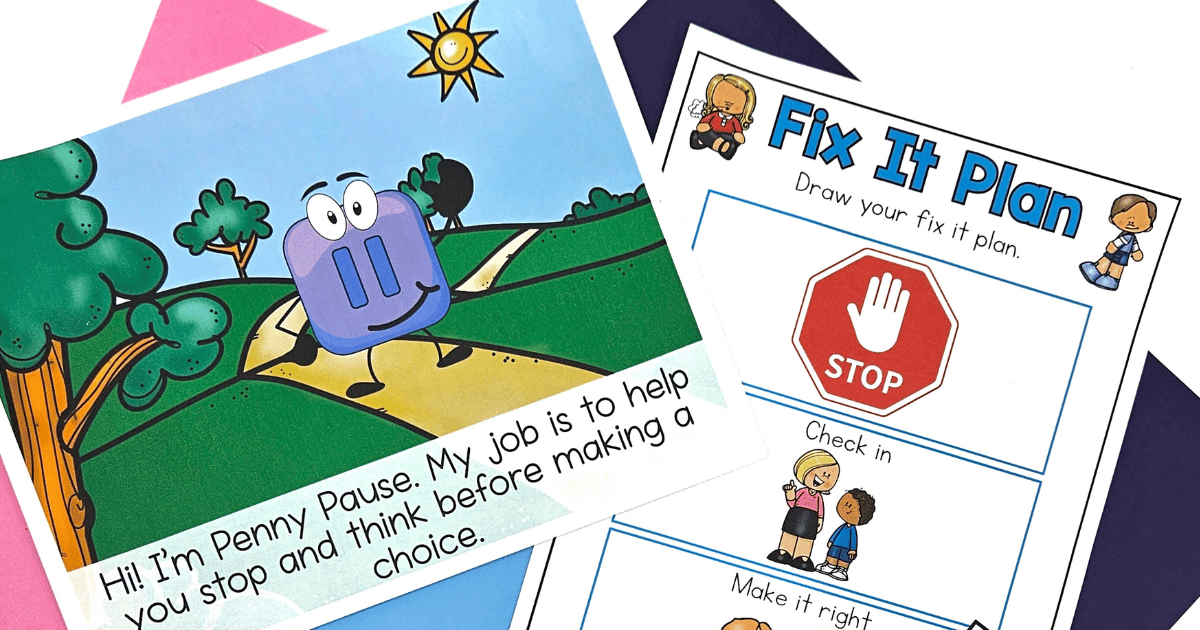
Why Visuals Matter So Much for Impulse Control
One of the biggest barriers for impulsive children is that their brain moves faster than words. By the time you’ve said, “Remember to raise your hand,” they’ve already blurted the answer. Not because they weren’t listening, but because their reaction outpaced the instruction. Blurting out is a common sign of impulse control issues, but visuals can help interrupt that cycle.
They slow the moment down just enough for the child to access the part of their brain that knows how to pause- also helpful for hyperactive behaviors too!
Using visuals intentionally give children a reference point: playing an important role of signaling what to do when their body wants to move quickly or when their emotions come in hot.
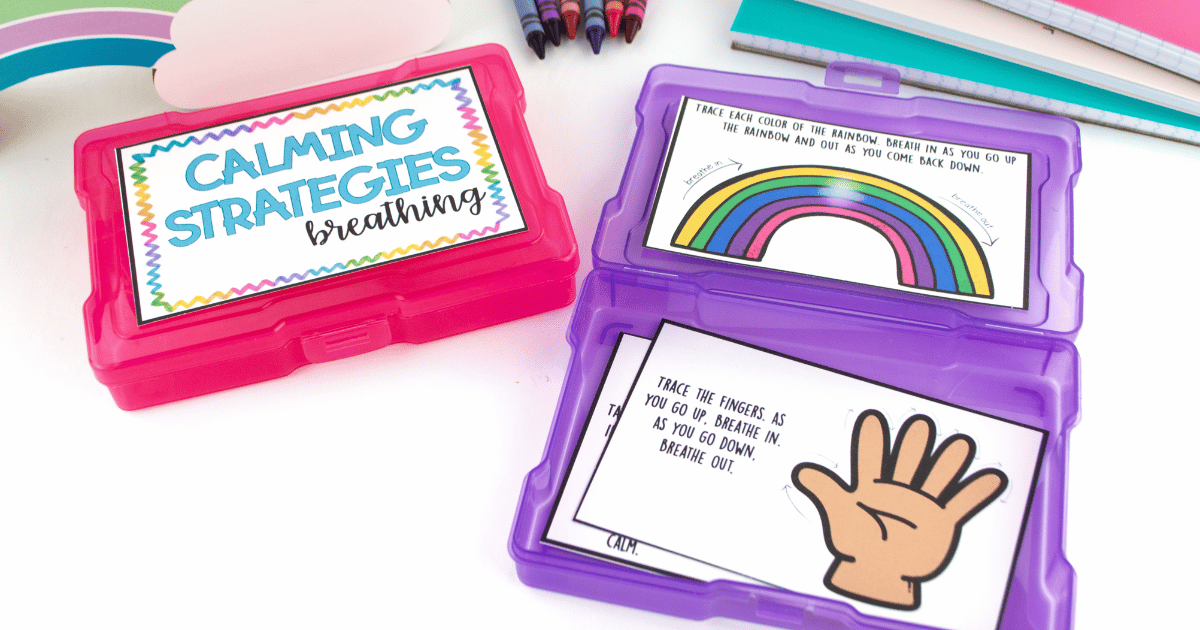
A child who sees a “Stop and Think” card has a much easier time remembering to pause before they interrupt conversations. A child who sees a “Calm Strategy” visual is more likely to use breathing or squeezing a fidget before reacting. A child who sees an “expected vs. unexpected” chart starts to internalize what school behavior looks like in various situations. They may not be full-proof, but the more consistent and supportive of positive behaviors you are, you’ll start to make the skill concrete.
Scenario-Based Practice Makes Self-Control Click
Here’s something adults often forget: kids learn through stories and situations far more effectively than they learn through lectures. Telling a child “don’t interrupt” doesn’t connect the way walking through a real scenario does:
“You’re working in a small group and you really, really want to tell me something. Your body feels like it needs to say it right away. What can you do instead?”
When children practice impulse control through familiar scenarios, role playing, and even traditional games, grabbing a marker without asking, running ahead in line, blurting during circle time, reacting quickly when frustrated begins to dwindle. The skill becomes personal, not theoretical.
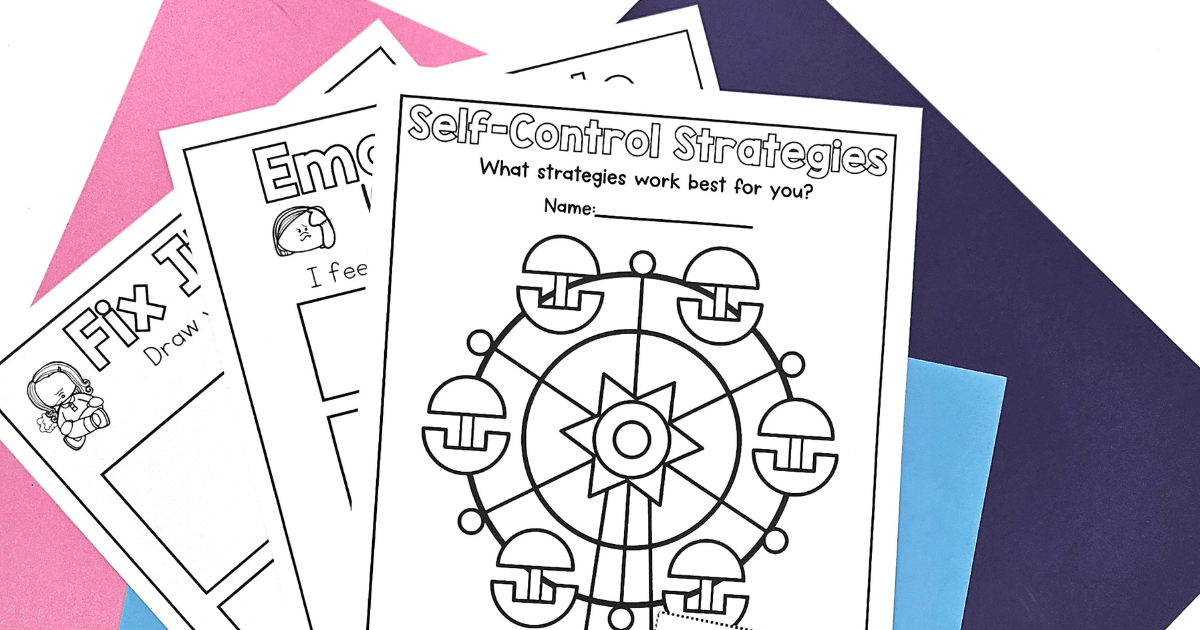
The Self-Control Mini Unit includes scenario-based lessons that help children practice appropriate responses long before the moment actually happens. This means that when the real situation comes up, they already have the blueprint.
This is where the growth happens, in the repeated playing, practicing, and trying again. You, as their role model, can work with them to keep practicing and making progress.
A Calm, Predictable Environment Supports Impulse Control
One of the biggest contributors to impulsive behavior is unpredictability. When children don’t know what’s happening next or what’s expected, their nervous system becomes more reactive.
Predictability doesn’t get rid of impulsivity entirely, but it dramatically reduces it.
A child who knows the morning routine, knows how transitions work, knows what to expect during partner work or whole-group lessons, will have an easier time controlling impulses. Their brain function isn’t operating on high alert. Instead, it’s grounded in structure.
This is why tools from the Mini Unit pair so naturally with your existing classroom routines.
A predictable environment doesn’t mean rigid. It means clear, consistent, and kind — three things children with impulse challenges benefit from deeply.

Celebrating Progress. Even the Smallest Steps.
Impulse control improves slowly, and never in a straight line. Some days will feel like tremendous progress, while others feel like starting from scratch. What children need most in that process is an adult who notices their effort and provides as early intervention as they can.
A child who managed to pause for half a second longer than yesterday?
That’s growth.
A child who raised their hand once before blurting the second time?
Still growth.
A child who used a calm strategy after reacting too quickly?
Growth.
And when you celebrate these moments, sincerely and consistently, you reinforce the identity of a child who can learn self-control, who is capable of making thoughtful choices, and who does have the tools.
There are reflection and Fix It opportunities in the unit that help students see and name their actions themselves, along with a plan for making it better, which can be incredibly empowering for children who feel like they’re “always in trouble.”
Kids Can Learn Impulse Control. They Just Need the Right Tools.
Impulse behavior in children can feel overwhelming, especially when it affects the flow of the classroom or creates conflict between peers. But it becomes far less overwhelming when we remember that impulsivity isn’t the markings of a bad kid-it’s a developmental stage that needs guidance.
Kids are not trying to make our lives harder. They are trying to navigate a world that expects more self-control than their brain is ready to give.
When we shift from reacting to behaviors to teaching the skills behind them, everything changes.
Children learn.
Confidence grows.
Frustration decreases.
And self-control becomes something they can actually practice. Not something we hope they magically develop.
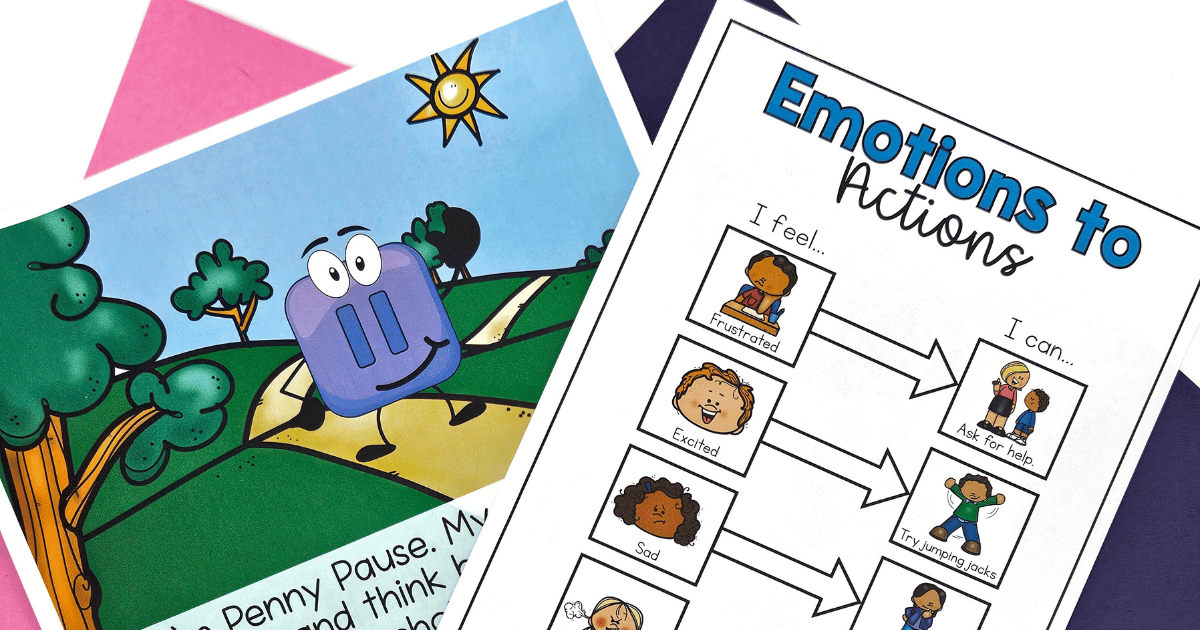
The Self-Control Mini Unit gives you the tools to teach impulse control step-by-step, with visuals, language, stories, and scenarios that make sense to children. It’s not about perfection. It’s about building capacity, slowly, steadily, and with compassion. The more support we give to school-aged children around controlling their emotions and behavior, the deeper relationships they’ll have.
Because with the right tools, kids can learn self-control.
And you’re already doing the most important part, showing up, supporting them, and believing they can grow.
Whether you choose to do this unit with your entire class, a small group, individual students, all in one week, spaced out over the course of a month, or a combination of the above, you’ll be able to increase self-control with short, meaningful lessons that your students will actually love.
I hope you enjoy this unit. I can’t wait to hear how your students do with it!